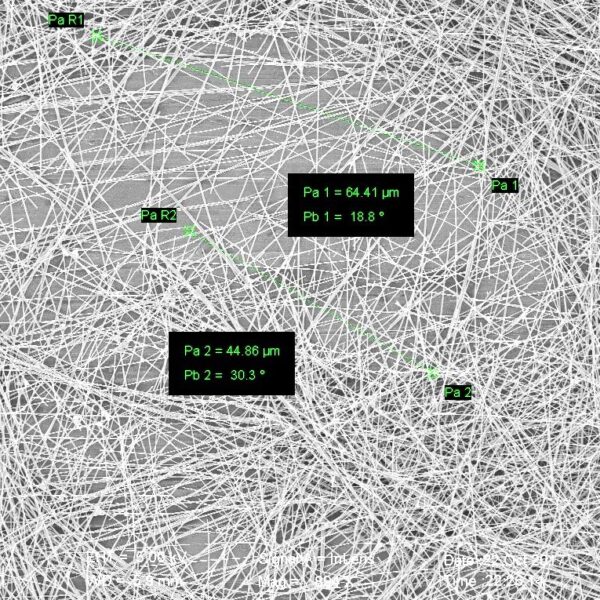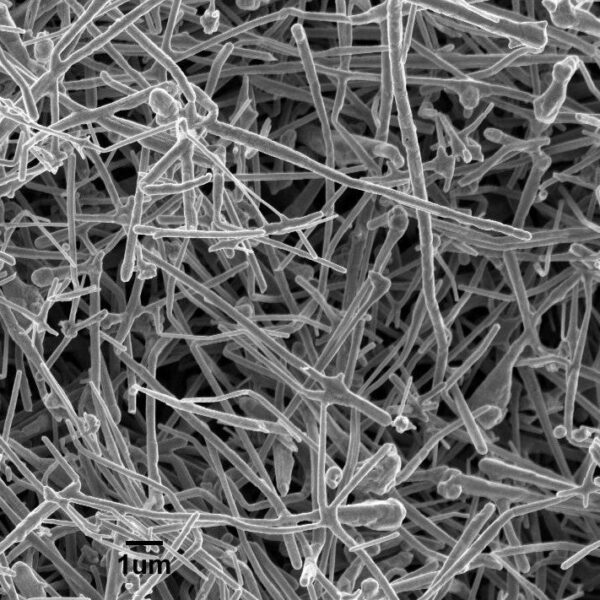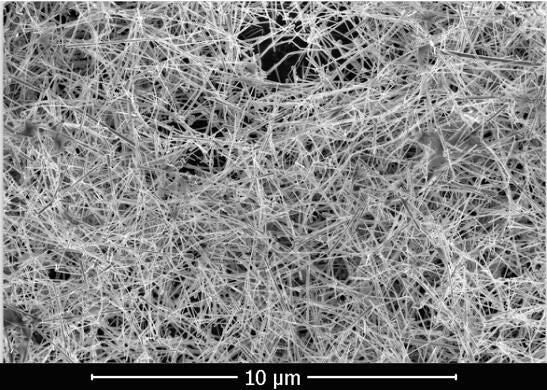

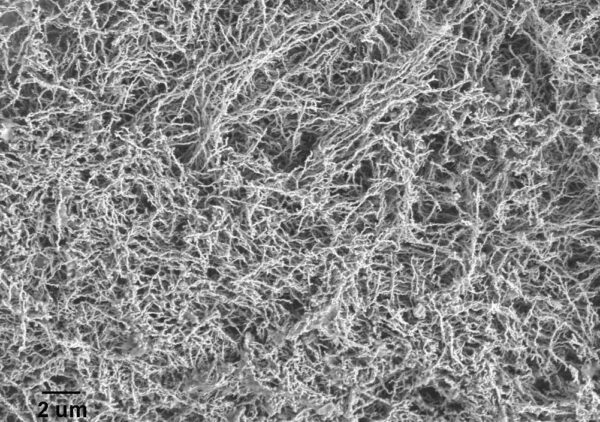
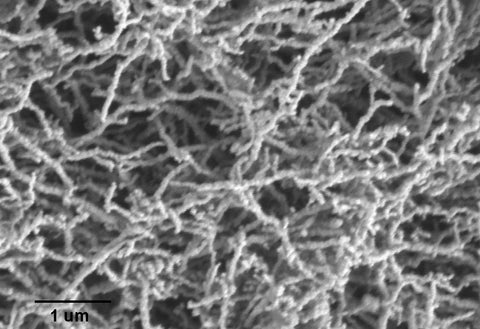

The Iron Nanowires (80 nm×10 µm) are ferromagnetic one-dimensional nanostructures developed for magnetic, electromagnetic, and multifunctional applications. Their ~80 nm diameter and ~10 µm length create a high-aspect-ratio morphology with substantial interfacial area and network-forming potential. The iron composition provides magnetic functionality and contributes to the electromagnetic response of compatible matrices. When incorporated into suitable material systems, the Fe nanowires can contribute to magnetic loss, interfacial polarization, electrical connectivity, and electromagnetic-energy dissipation. These characteristics make them suitable for research and material development involving radio-frequency attenuation, microwave absorption, EMI shielding, and radar-absorbing materials.
Catalog Number: NovaWire-Fe-80
Diameter: ~80 nm
Length: ~10 µm
Appearance: black suspension in water
Availability: Kilogram-scale quantities available upon request
KEY FEATURES
The Iron Nanowires combine magnetic functionality, electromagnetic response, and a high-aspect-ratio morphology for advanced material development.
- Ferromagnetic composition: Provides magnetic functionality for electromagnetic and magnetically responsive material systems.
- Electromagnetic response: Supports research involving radio-frequency attenuation, microwave absorption, and electromagnetic-energy management.
- Magnetic-loss behavior: May contribute to energy dissipation in properly designed absorber systems.
- Interconnected structure formation: The elongated morphology can promote wire-to-wire contact and network formation within compatible matrices.
- High-aspect-ratio morphology: Combines a nanoscale diameter with a micrometer-scale length, enabling substantial interaction with the surrounding matrix.
APPLICATIONS
The Iron Nanowires are suited for research and development across the following magnetic and electromagnetic applications:
- Radio-frequency and electromagnetic-wave absorption.
- Microwave-absorbing coatings and composites.
- Radar-absorbing material research.
- EMI-shielding materials and electronic enclosures.
- Magnetic and electrically active polymer composites.
- Antistatic and electrostatic-dissipation materials.
- Magnetic sensors and sensing elements.
- Catalyst and catalyst-support systems.
- Magnetically recoverable materials.
- Magnetic separation and recovery processes.
- Multifunctional coatings, ceramics, and composite systems.
SYNONYM
Iron nanowires, iron nanofibers, iron, Fe nanowires, Fe nanofibers, Fe, metallic nanowires, metallic nanofibers, metal nanowires, metal nanofibers, magnetic nanowires, magnetic nanofibers, ferromagnetic nanowires, ferromagnetic nanofibers, non-precious metal nanowires, non-precious metal nanofibers, conductive nanowires, conductive nanofibers, iron nanowire, iron nanofiber, Fe nanowire, Fe nanofiber, metallic nanowire, metallic nanofiber, metal nanowire, metal nanofiber, magnetic nanowire, magnetic nanofiber, ferromagnetic nanowire, ferromagnetic nanofiber, non-precious metal nanowire, non-precious metal nanofiber, conductive nanowire, conductive nanofiber.
REFERENCES
- R. Liu, M. Ltoh, M. Terada, T. Horikawa, and K. I. Machida, “Enhanced electromagnetic wave absorption properties of Fe nanowires in gigaherz range”, Appl. Phys. Lett., 2007, 91, 093101.
- Han, W. Tang, W. Chen, H. Zhou, and L. Deng, “Effect of shape of Fe particles on their electromagnetic properties within 1–18 GHz range”, J. Appl. Phys., 2010, 107, 09A958.
SDS
RELATED NANOWIRE MATERIALS
Explore other metallic nanowire materials for conductive, magnetic, and electromagnetic applications: